.Google ditched autopilot driving feature after users napped behind the wheel

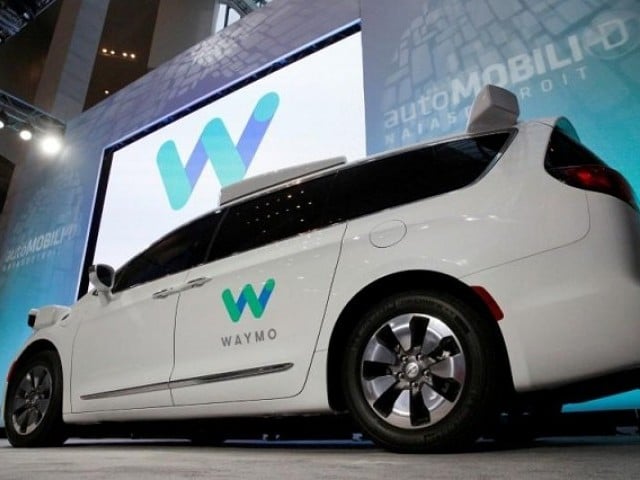
Waymo unveils a self-driving Chrysler Pacifica minivan during the North American International Auto Show in Detroit, Michigan, U.S., January 8, 2017.  
PHOTO: REUTERS
Waymo unveils a self-driving Chrysler Pacifica minivan during the North American International Auto Show in Detroit, Michigan, U.S., January 8, 2017. PHOTO: REUTERS
Alphabet’s self-driving car unit stopped developing features that required drivers to take control in dangerous situations, its chief executive said Monday, as autopilot reliance left users prone to distractions and ill-prepared to maneuver.
The decision followed experiments of the technology in Silicon Valley that showed test users napping, putting on makeup and fiddling with their phones as the vehicles traveled up to 56 mph.
John Krafcik, the head of Waymo, which was formed in 2009 as a project within Alphabet’s Google unit, told reporters that about five years ago the company envisioned technology that could autonomously drive cars on highways as a quick way to get on the market.
Other self-driving automakers include similar autopilot features for highway-driving in vehicles, but they require drivers to take over the steering wheel in tricky situations. Waymo planned to do the same.
“What we found was pretty scary,” Krafcik said on Monday during a media tour of a Waymo testing facility. “It’s hard to take over because they have lost contextual awareness.”
Krafcik said the company determined a system that asked drivers to jump in at the sound of an alert was unsafe after seeing videos from inside self-driving cars during tests.
The filmed tests were conducted in 2013, with Google employees behind the wheel. The videos had not been publicly shown until Monday’s event, Waymo spokeswoman Lauren Barriere said.
The company decided to focus solely on technology that didn’t require human intervention a couple of days after the napping incident, said Krafcik, who joined as CEO in 2015. It has also since argued against allowing “handoffs” between automated driving systems and people.
“Our technology takes care of all of the driving, allowing passengers to stay passengers,” the company said in a report this month.
The two drive controls provided to passengers in Waymo’s Chrysler Pacifica minivans are buttons for starting a ride and asking the vehicles to pull over at their next chance.
Waymo is running a ride-hailing pilot program around Phoenix, Arizona that chauffeurs an undisclosed, but growing number of users in self-driving cars. The service area is limited to well-mapped roads on which Waymo has extensively tested.
Krafcik declined to specify when the company would expand beyond the small experiment, saying only that such a moment is getting “close.”
He reiterated that the company is simultaneously also identifying ways to launch self-driving trucks, municipal transit services and partnerships with carmakers.
“We see four potential applications, whether it’s Waymo branded or not,” he said.

Comments

Popular posts from this blog

This startup is pairing the blockchain with farming

Ripe, a blockchain startup, is  showcasing  how the distributed ledger technology can be applied to farming and provide companies with important data on crops and throughout the supply chain. By combining a blockchain with purpose-built scanners and specialized sensors, the company is able to provide critical data that is easily communicated to partners, demonstrating why  blockchain is growing more popular  as a tool to be leveraged as part of an IoT solution. Blockchain is a key tool for the IoT because of how it combines data storage and communication in a trusted medium. A blockchain is a shared, distributed database  that acts as an immutable ledger, recording entries and verifying them across a number of independent participants. Once an entry is made, it’s marked with a unique hash code that places it sequentially in the ledger. In agriculture, this means that farmers can use sensors and handheld devices to gather data about crops like tomatoes...

Honda Launches the CR-V SUV in Pakistan

The 2018 Honda CR-V has been launched in Pakistan and it looks charming. Honda has finally launched the 2018 Honda CR-V in Pakistan. This Sports Utility Vehicle (SUV) has proven to be pretty popular around the world with an average of 300,000 units sold annually. In Pakistan, the Honda CR-V is gaining the popularity and attention of local auto enthusiasts. Honda CR-V 2018 was recognized as ‘2018 Motor Trend SUV of the year’ recently as well. The international model of CR-V has these four variants: Honda CR-V LX (Standard), Honda CR-V EX, Honda CR-V EX-L, Honda CR-V Touring. The CR-V offers pretty great features when you look at it. Let's take a look at what Honda Compact Recreational Vehicle (CR-V) has to offer. Exterior Because of its shiny new sporty-looking exterior, the vehicle is placed in small sports utility vehicle’s category. The exterior, no doubt, makes you want to look twice as some modifications to the previous model have been made. ...

Samsung Launches Mid-Range Galaxy Wide 3

HANDSETS Check out Samsung’s new low-mid segment smartphone, the Galaxy Wide 3 with 3300 mAh battery and a 5.5-inch display. Samsung unveiled Galaxy Wide 3 for the South Korean market featuring low-mid specifications, and a design much similar to the well-known Galaxy J series. It does not follow the sweet bezel-less display trend, albeit comes with decent specifications for all those Samsung fans out there. Design & Display As you’d expect, the design is fairly simple with large bezels that house Samsung’s signature hardware button configuration, with the company’s latest icons for the back and menu button. The volume rocker looks modern and is housed on the left edge of the phone. The display is a 5.5-inch HD (720 x 1280) unit, an IPS LCD, with no edge-to-edge aesthetic. Huawei Unveils 8e Youth With a Tall Display & Android Oreo For Cheap Hardware & Storage The Galaxy Wide 3 is powered by Samsung’s Exynos 7870, octa-core, clocked at 1.6 G...