
Bitcoin and almost all other altcoins crashed hard today


If you have observed only Bitcoin crashing hard today, let us prove you wrong as almost every other major cryptocurrency has seen a drop-off today. In the past couple of months, Bitcoin is continuously seeing a surge in price, where it reached $19,000 from $6,000 only. However, during the recent hours, Bitcoin’s price dipped down to $12,000, however, it is currently trading at $13,600, as of writing.


The extreme drop down of $4000 in the value of the Bitcoin is the highest recorded value loss during the year 2017. Well, today’s drop-off is not just limited to the king of cryptocurrencies, it has affected several other altcoins. According to the Coinmarketcap, Ethereum observed a drop down of 20%, Bitcoin Cash has gone 30% below, Lite coin went below by 21%, and almost every other high-profile altcoin observed a down in the past 24 hours.
According to a tweet by a TechCrunch’s author Jon Russell,
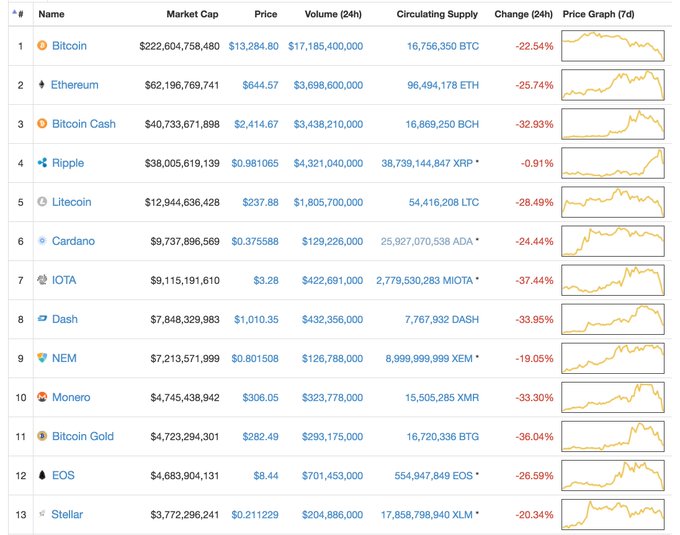
Bitcoin isn’t the only crypto plunging, all but two of the most valuable 100 coins are down in value over the last 24 hours https://coinmarketcap.com/ 
Well, luckily some cryptocurrencies have been successful to survive this stroke. Ripple has been observed to a slight growth of 7%, and it has crossed historic $1 barrier for the first time. The Coinmarketcap data also reveals that only one of every two coins have remained green over the past day.
What’s causing this extreme disruption in cryptocurrency’s value still needed to be explored? As nobody knows exactly why Bitcoin’s price has boosted up by 1700% in a single year, so it also remains a mystery that why these cryptocurrencies are facing this downfall.
As the Goldman Sach is preparing to trade Bitcoin and other cryptocurrencies in next year, so we are most likely to see an increase in prices in 2018. Meanwhile, the CBOE and CME have already announced trading in cryptocurrencies, so the future appears to be bright.

Comments

Popular posts from this blog

POS

POINT OF SALE Point of sale  (also called  POS  or  checkout , during computerization later becoming  electronic point of sale  or  EPOS ) is the place where a retail transaction is completed. It is the point at which a customer makes a payment to the merchant in exchange for goods or services. At the point of sale the retailer would calculate the amount owed by the customer and provide options for the customer to make payment. The merchant will also normally issue a receipt for the transaction. The POS in various retail industries uses customized hardware and software as per their requirements. Retailers may utilize weighing scales, scanners, electronic and manual cash registers, EFTPOS terminals, touch screens and any other wide variety of hardware and software available for use with POS. For example, a grocery or candy store uses a scale at the point of sale, while bars and restaurants use software to customize the item or service s...

Li-Fi

Li-Fi Light Fidelity  ( Li-Fi ) is a bidirectional, high-speed and fully networked wireless communication technology similar to Wi-Fi. The term was coined by Harald Haas and is a form of visible light communication and a subset of optical wireless communications (OWC) and could be a complement to RF communication (Wi-Fi or cellular networks), or even a replacement in contexts of data broadcasting. It is wire and uv visible-light communication or infrared and near-ultraviolet instead of radio-frequency spectrum, part of optical wireless communications technology, which carries much more information and has been proposed as a solution to the RF-bandwidth limitations. Technology details This OWC technology uses light from light-emitting diodes (LEDs) as a medium to deliver networked, mobile, high-speed communication in a similar manner to Wi-Fi. The ...

This startup is pairing the blockchain with farming

Ripe, a blockchain startup, is  showcasing  how the distributed ledger technology can be applied to farming and provide companies with important data on crops and throughout the supply chain. By combining a blockchain with purpose-built scanners and specialized sensors, the company is able to provide critical data that is easily communicated to partners, demonstrating why  blockchain is growing more popular  as a tool to be leveraged as part of an IoT solution. Blockchain is a key tool for the IoT because of how it combines data storage and communication in a trusted medium. A blockchain is a shared, distributed database  that acts as an immutable ledger, recording entries and verifying them across a number of independent participants. Once an entry is made, it’s marked with a unique hash code that places it sequentially in the ledger. In agriculture, this means that farmers can use sensors and handheld devices to gather data about crops like tomatoes...