This is the huge rocket that will take Elon Musk’s Tesla to Mars next month

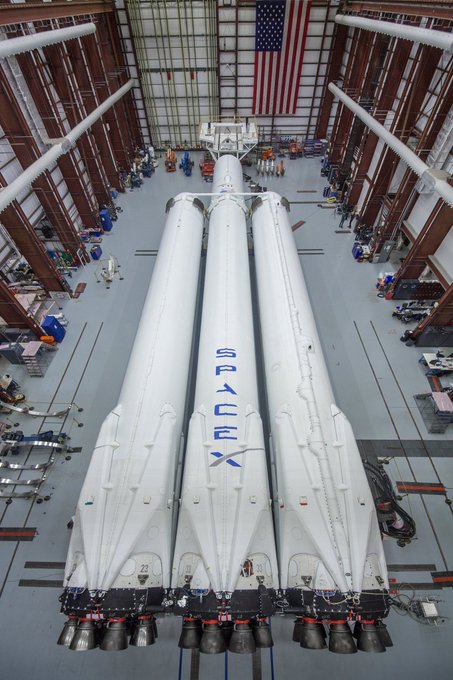
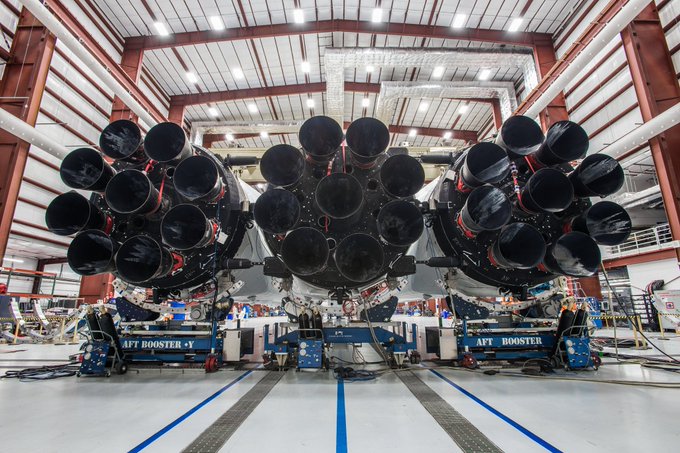
As we earlier reported that Elon Musk is planning to send his personal Tesla’s Roadster to Mars on SpaceX’s Falcon Heavy and now the tech-billionaire has revealed images of the Payload’s career via a tweet. Elon Musk has tweeted photos of Space X’s almost fully assembled Falcon Heavy Rocket in a hanger in Florida, where the work is going on for its proposed launch of January.

The images show the biggest and best glimpse, of what Space X has been up to during the recent years. After years of working, Elon Musk has finally unveiled three Falcon 9 rockets strapped together. Falcon Heavy will be launched for the same old legendary launch pad of Apollo 11 which took first earthlings to the moon. Revealing images of the new Falcon Heavy, Elon Musk, wrote simple five words about the launch, “Falcon Heavy at the Cape”, in his old-fashioned way.
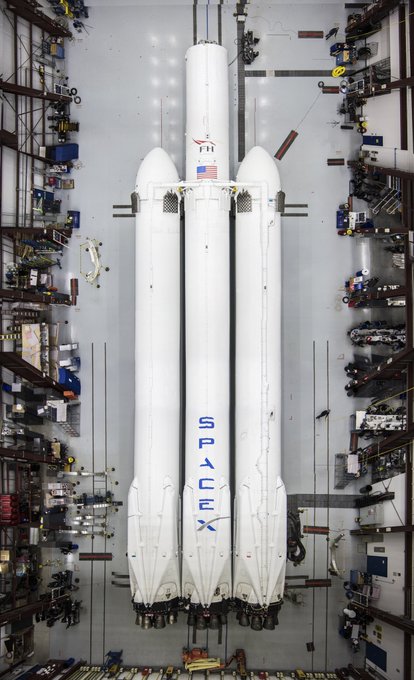
The three Falcon 9 rockets would be almost reusable and all the three cores are most likely to arrive back on earth so they might be used in other missions. Musk has also revealed that these three rockets have an outer which has been previously flown for Falcon 9 boosters.
Falcon Heavy is capable to lift much more than just Tesla’s sports car. It’s 27 Merlin engines can generate over 5 million pounds of thrust which enable the rocket to lift fully loaded 737 jetliners into orbit.

The SpaceX’s Falcon Heavy Mission which is apparently projected towards Mars will have a rocket which is capable of using 92% of its capabilities. So far, it’s hard to believe that this mission will be successful as Falcon Heavy may not be able to orbit around Mars’ orbit. However, Elon Musk has already proven his claims so there will be no surprise if he’s able to do that too.

Comments

Popular posts from this blog

POS

POINT OF SALE Point of sale  (also called  POS  or  checkout , during computerization later becoming  electronic point of sale  or  EPOS ) is the place where a retail transaction is completed. It is the point at which a customer makes a payment to the merchant in exchange for goods or services. At the point of sale the retailer would calculate the amount owed by the customer and provide options for the customer to make payment. The merchant will also normally issue a receipt for the transaction. The POS in various retail industries uses customized hardware and software as per their requirements. Retailers may utilize weighing scales, scanners, electronic and manual cash registers, EFTPOS terminals, touch screens and any other wide variety of hardware and software available for use with POS. For example, a grocery or candy store uses a scale at the point of sale, while bars and restaurants use software to customize the item or service s...

Li-Fi

Li-Fi Light Fidelity  ( Li-Fi ) is a bidirectional, high-speed and fully networked wireless communication technology similar to Wi-Fi. The term was coined by Harald Haas and is a form of visible light communication and a subset of optical wireless communications (OWC) and could be a complement to RF communication (Wi-Fi or cellular networks), or even a replacement in contexts of data broadcasting. It is wire and uv visible-light communication or infrared and near-ultraviolet instead of radio-frequency spectrum, part of optical wireless communications technology, which carries much more information and has been proposed as a solution to the RF-bandwidth limitations. Technology details This OWC technology uses light from light-emitting diodes (LEDs) as a medium to deliver networked, mobile, high-speed communication in a similar manner to Wi-Fi. The ...

This startup is pairing the blockchain with farming

Ripe, a blockchain startup, is  showcasing  how the distributed ledger technology can be applied to farming and provide companies with important data on crops and throughout the supply chain. By combining a blockchain with purpose-built scanners and specialized sensors, the company is able to provide critical data that is easily communicated to partners, demonstrating why  blockchain is growing more popular  as a tool to be leveraged as part of an IoT solution. Blockchain is a key tool for the IoT because of how it combines data storage and communication in a trusted medium. A blockchain is a shared, distributed database  that acts as an immutable ledger, recording entries and verifying them across a number of independent participants. Once an entry is made, it’s marked with a unique hash code that places it sequentially in the ledger. In agriculture, this means that farmers can use sensors and handheld devices to gather data about crops like tomatoes...