
Are Software Algorithms racially biased too?


MIT’s (Massachusetts Institute of Technology) Media Lab is conducting research that facial recognition technology tends to be biased in facial recognition for females and dark-colored skin tone people. Evidence shows that the software has been inaccurate in decision-making due to the way it is programmed to work.


The researcher at MIT Joy Buolamwini has stated that; “I found out that there is a problem with facial- recognition software when I noticed software precisely recognized my face faster and accurate when I have put on the white mask on my face”. Before MIT statement people only made speculations about this issue for dark colored people.
Buolamwini tested three facial recognition systems including; Microsoft, IBM, Megvii of China. All tests clearly showed the inaccurate facial recognition on basis of a person’s skin color and gender; the results were originally reported in The New York Times.
“Overall, male subjects were more accurately classified than female subjects replicating previous findings (Ngan et al., 2015), and lighter subjects were more accurately classified than darker individuals,” Buolamwini wrote in this paper. It shows that software accurately detects white colored men as compared to females or dark-skinned men.
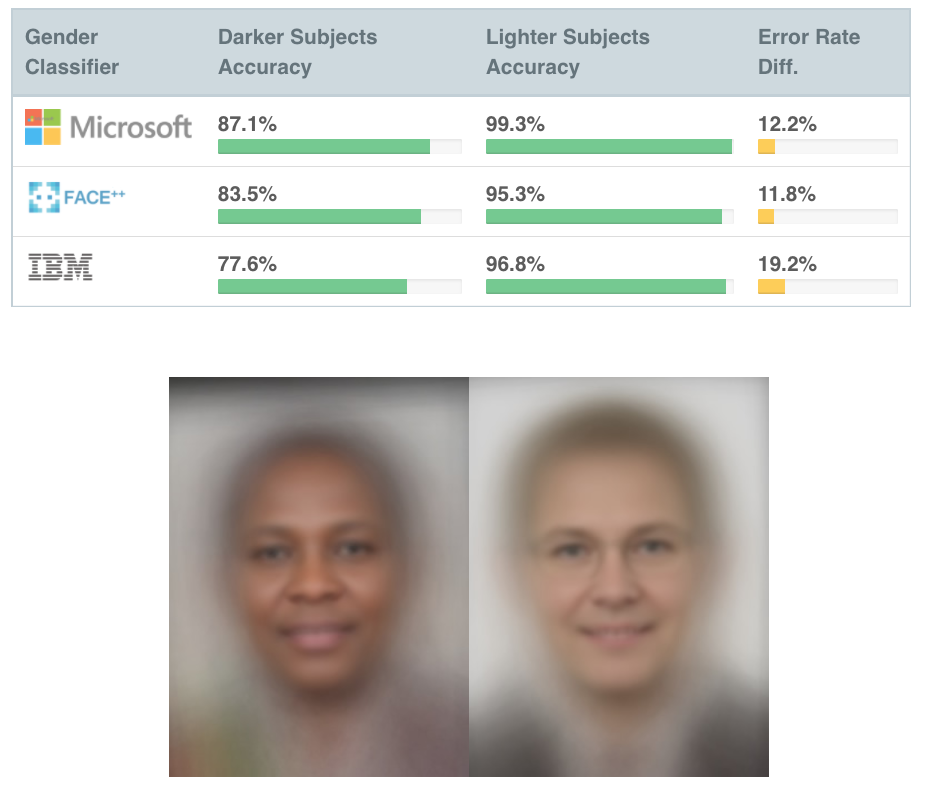
Furthermore, cameras that are deployed for security checks seem to have similar limitations. A lot of innocent people have been suspected of wrongdoings owing to inaccurate results from the camera software.
This is not the first time that a research shows that software is racially discriminating. Back in 2015, Google was called out by a software engineer for mistakenly identifying his black friends as “gorillas”. We are still unsure whether that problem solved or Google just marked off “Gorilla” word from its face-detection algorithm.
It is true that software is neutral and totally relies on its programmers. If the data-set fed into it works fine, we will never face such issues in future.

Comments

Popular posts from this blog

This startup is pairing the blockchain with farming

Ripe, a blockchain startup, is  showcasing  how the distributed ledger technology can be applied to farming and provide companies with important data on crops and throughout the supply chain. By combining a blockchain with purpose-built scanners and specialized sensors, the company is able to provide critical data that is easily communicated to partners, demonstrating why  blockchain is growing more popular  as a tool to be leveraged as part of an IoT solution. Blockchain is a key tool for the IoT because of how it combines data storage and communication in a trusted medium. A blockchain is a shared, distributed database  that acts as an immutable ledger, recording entries and verifying them across a number of independent participants. Once an entry is made, it’s marked with a unique hash code that places it sequentially in the ledger. In agriculture, this means that farmers can use sensors and handheld devices to gather data about crops like tomatoes...

Honda Launches the CR-V SUV in Pakistan

The 2018 Honda CR-V has been launched in Pakistan and it looks charming. Honda has finally launched the 2018 Honda CR-V in Pakistan. This Sports Utility Vehicle (SUV) has proven to be pretty popular around the world with an average of 300,000 units sold annually. In Pakistan, the Honda CR-V is gaining the popularity and attention of local auto enthusiasts. Honda CR-V 2018 was recognized as ‘2018 Motor Trend SUV of the year’ recently as well. The international model of CR-V has these four variants: Honda CR-V LX (Standard), Honda CR-V EX, Honda CR-V EX-L, Honda CR-V Touring. The CR-V offers pretty great features when you look at it. Let's take a look at what Honda Compact Recreational Vehicle (CR-V) has to offer. Exterior Because of its shiny new sporty-looking exterior, the vehicle is placed in small sports utility vehicle’s category. The exterior, no doubt, makes you want to look twice as some modifications to the previous model have been made. ...

Samsung Launches Mid-Range Galaxy Wide 3

HANDSETS Check out Samsung’s new low-mid segment smartphone, the Galaxy Wide 3 with 3300 mAh battery and a 5.5-inch display. Samsung unveiled Galaxy Wide 3 for the South Korean market featuring low-mid specifications, and a design much similar to the well-known Galaxy J series. It does not follow the sweet bezel-less display trend, albeit comes with decent specifications for all those Samsung fans out there. Design & Display As you’d expect, the design is fairly simple with large bezels that house Samsung’s signature hardware button configuration, with the company’s latest icons for the back and menu button. The volume rocker looks modern and is housed on the left edge of the phone. The display is a 5.5-inch HD (720 x 1280) unit, an IPS LCD, with no edge-to-edge aesthetic. Huawei Unveils 8e Youth With a Tall Display & Android Oreo For Cheap Hardware & Storage The Galaxy Wide 3 is powered by Samsung’s Exynos 7870, octa-core, clocked at 1.6 G...