
HP launches a new range of EliteBooks with built-in webcam cover


HP’s new EliteBook range this year provides a shutter for webcam and external mic for better voice distribution with other tools for their users.
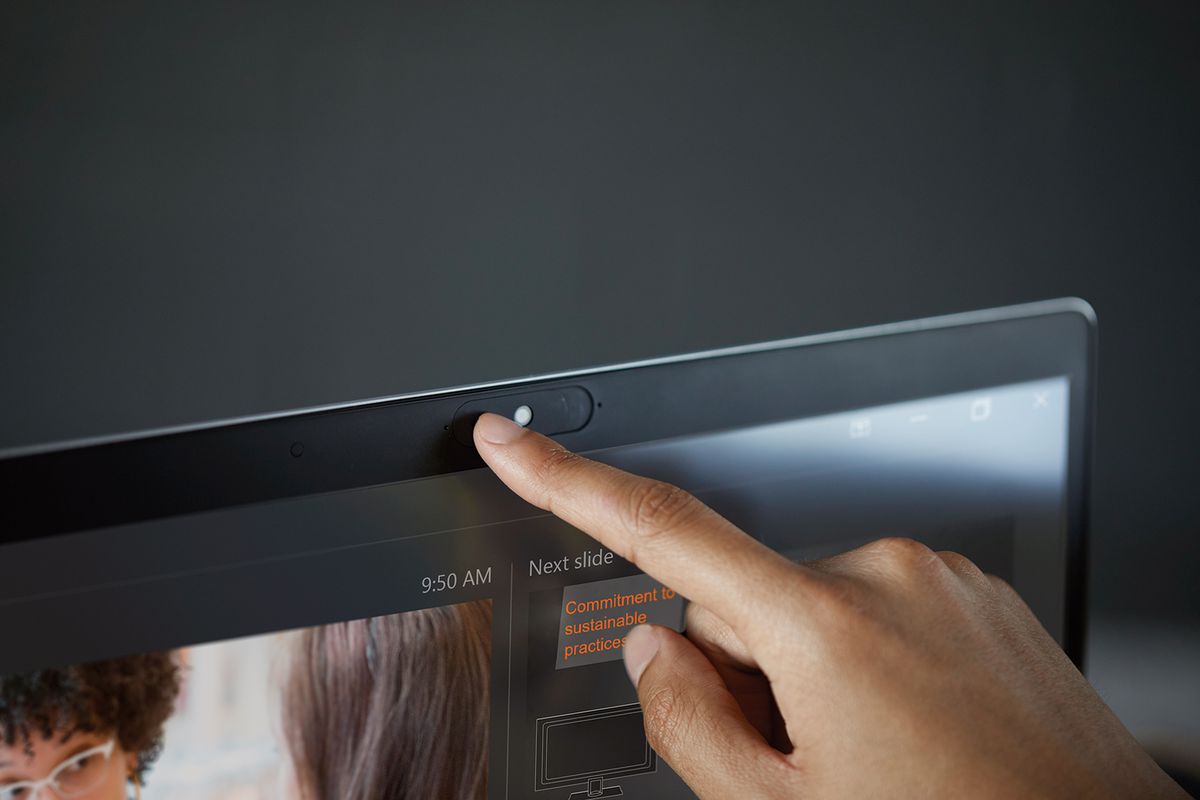
HP has recently launched a new range of EliteBook 800 series laptops and monitors but main pointers of these products in a public view are: which is used to cover Webcam, so you are ensured that one is not being watched. Secondly, Mics on both sides for clearer sound are also added.
The three new refreshed models of HP’s EliteBook are providing a shutter for webcam in their default configuration. The models are dubbed as the fifth-generation EliteBooks 830, 840, and 850, as reported by The Verge.
But if you want to upgrade your system into touchscreen than according to HP’s management the bezels don’t have enough space to include cover for Webcam too.
HP isn’t the only one with this feature, two years back Lenovo provided Webcam cover in its ThinkPad laptops but respectively this feature is still new in sense of security.
The exciting thing is two-faced mic one placed on the outside of laptop’s lid which is basically used to cover other voices while you are in a meeting and other people are participating, so external mic will help to distinguish their voices from yours. While individual mic helps in noise reduction and gives a clearer projection of your voice. This feature will not only be used for Skype calls as built-in noise cancellation software but also for “PC Calls”.
Other than that EliteBook refreshed version of workstation laptops ZBook 14uand 15u have design changes and are deemed to be “World thinnest mobile Workstation”. HP has also announced three new 4K Displays for Zbook 27-, 31.5-, and 42.5-inch models.
There have been rumors that these three EliteBook Laptops will go on sale this month with prices starting from $1,029. Later on, Zbook Model will also make their place towards the market with starting range at $1,099.
Image Source: Engadget

Comments

Popular posts from this blog

POS

POINT OF SALE Point of sale  (also called  POS  or  checkout , during computerization later becoming  electronic point of sale  or  EPOS ) is the place where a retail transaction is completed. It is the point at which a customer makes a payment to the merchant in exchange for goods or services. At the point of sale the retailer would calculate the amount owed by the customer and provide options for the customer to make payment. The merchant will also normally issue a receipt for the transaction. The POS in various retail industries uses customized hardware and software as per their requirements. Retailers may utilize weighing scales, scanners, electronic and manual cash registers, EFTPOS terminals, touch screens and any other wide variety of hardware and software available for use with POS. For example, a grocery or candy store uses a scale at the point of sale, while bars and restaurants use software to customize the item or service s...

Li-Fi

Li-Fi Light Fidelity  ( Li-Fi ) is a bidirectional, high-speed and fully networked wireless communication technology similar to Wi-Fi. The term was coined by Harald Haas and is a form of visible light communication and a subset of optical wireless communications (OWC) and could be a complement to RF communication (Wi-Fi or cellular networks), or even a replacement in contexts of data broadcasting. It is wire and uv visible-light communication or infrared and near-ultraviolet instead of radio-frequency spectrum, part of optical wireless communications technology, which carries much more information and has been proposed as a solution to the RF-bandwidth limitations. Technology details This OWC technology uses light from light-emitting diodes (LEDs) as a medium to deliver networked, mobile, high-speed communication in a similar manner to Wi-Fi. The ...

Infrared

Infrared Infrared radiation , or simply  infrared  or  IR , is electromagnetic radiation (EMR) with longer wavelengths than those of visible light, and is, therefore, invisible, although it is sometimes loosely called  infrared light . It extends from the nominal red edge of the visible spectrum at 700 nanometers (frequency 430 THz), to 1000000 nm (300 GHz) (although people can see infrared up to at least 1050 nm in experiments). Most of the thermal radiation emitted by objects near room temperature is infrared. Like all EMR, IR carries radiant energy, and behaves both like a wave and like its quantum particle, the photon. Infrared was discovered in 1800 by astronomer Sir William Herschel, who discovered a type of invisible radiation in the spectrum lower in energy than red light, by means of its effect on a thermometer. Slightl...