
Pakistani students to participate in Make the Future Singapore festival

640px-Khadi34

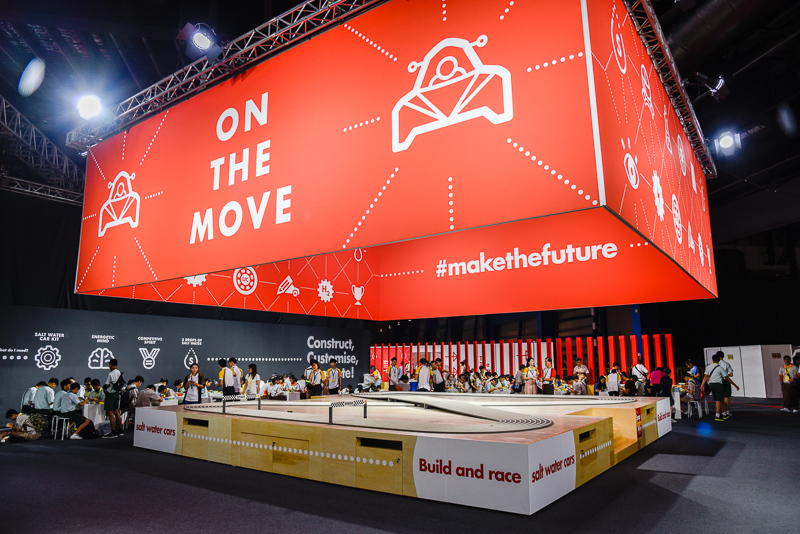
Recently, it has been reported that students from Pakistan will be competing in the Make the Future Singapore – a free festival for Asia, filled with bright energy ideas and innovations. The public festival will commence on March 8 and will continue for three more days, ending on March 11, 2018. It is returning to Singapore for the second year and will take place at the country’s Changi Exhibition Centre.


Shell Eco-marathon Asia is known to be one of the world’s longest-running student competition and will reportedly be the festival’s headline. The contest will include over 120 teams of students from 18 countries across the Asia Pacific and the Middle East that would compete with their self-built energy-efficient cars.
Pakistan has participated in this marathon before and now, it will be taking part once again with 10 futuristic cars from seven universities to prove which one is the most energy-efficient.
Following are some of the participating teams:
Team Urban Ghulam Ishaq Khan Institute, category: Urban Concept ICE (Gasoline), Team Innova, University Pakistan Institute of Engineering and Applied Sciences, category: Urban Concept Vehicle, Team Mech the Tech, Air University, category: Battery Electric, while two Teams participating from National University of Sciences & Technology, Karachi include PNEC-NUST-URBAN, and PNEC-NUST-PROTOTYPE, in the Gasoline and Battery Electric category respectively.
makethefuture-1
More on the occasion, it will be a platform encouraging conversation, collaboration with young scientists and innovative start-ups concerning the global energy challenge. There will be VR-based technology for the people to enlighten them about what is currently in action to produce the power in the world.
With the hands-on experiences, the productive ideas from all around Asia will be explored. There will be events like dancing and playing interactive games primarily to generate the electrical energy. There will be building and racing of the mini saltwater cars as well. On the whole, the people would be able to get a glimpse of the energy production’s future.
For more on the education and technology, keep following TechJuice

Comments

Popular posts from this blog

POS

POINT OF SALE Point of sale  (also called  POS  or  checkout , during computerization later becoming  electronic point of sale  or  EPOS ) is the place where a retail transaction is completed. It is the point at which a customer makes a payment to the merchant in exchange for goods or services. At the point of sale the retailer would calculate the amount owed by the customer and provide options for the customer to make payment. The merchant will also normally issue a receipt for the transaction. The POS in various retail industries uses customized hardware and software as per their requirements. Retailers may utilize weighing scales, scanners, electronic and manual cash registers, EFTPOS terminals, touch screens and any other wide variety of hardware and software available for use with POS. For example, a grocery or candy store uses a scale at the point of sale, while bars and restaurants use software to customize the item or service s...

Li-Fi

Li-Fi Light Fidelity  ( Li-Fi ) is a bidirectional, high-speed and fully networked wireless communication technology similar to Wi-Fi. The term was coined by Harald Haas and is a form of visible light communication and a subset of optical wireless communications (OWC) and could be a complement to RF communication (Wi-Fi or cellular networks), or even a replacement in contexts of data broadcasting. It is wire and uv visible-light communication or infrared and near-ultraviolet instead of radio-frequency spectrum, part of optical wireless communications technology, which carries much more information and has been proposed as a solution to the RF-bandwidth limitations. Technology details This OWC technology uses light from light-emitting diodes (LEDs) as a medium to deliver networked, mobile, high-speed communication in a similar manner to Wi-Fi. The ...

This startup is pairing the blockchain with farming

Ripe, a blockchain startup, is  showcasing  how the distributed ledger technology can be applied to farming and provide companies with important data on crops and throughout the supply chain. By combining a blockchain with purpose-built scanners and specialized sensors, the company is able to provide critical data that is easily communicated to partners, demonstrating why  blockchain is growing more popular  as a tool to be leveraged as part of an IoT solution. Blockchain is a key tool for the IoT because of how it combines data storage and communication in a trusted medium. A blockchain is a shared, distributed database  that acts as an immutable ledger, recording entries and verifying them across a number of independent participants. Once an entry is made, it’s marked with a unique hash code that places it sequentially in the ledger. In agriculture, this means that farmers can use sensors and handheld devices to gather data about crops like tomatoes...