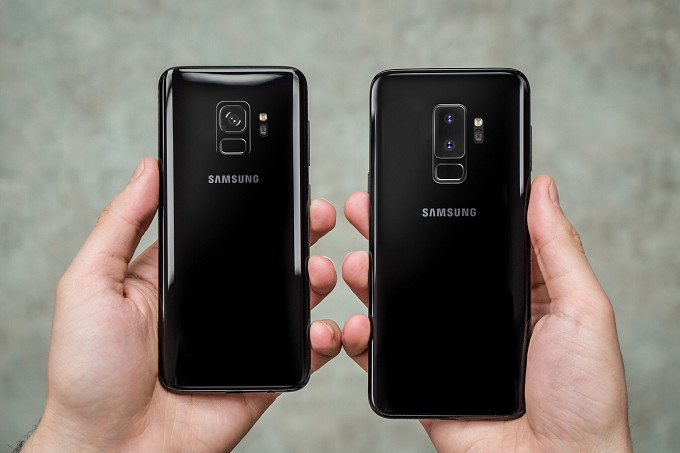
Samsung is all in on Galaxy S9 to beat Apple’s iPhone X


Samsung is going to launch its new Galaxy, the S9 flagship next week with the more advanced feature as per rumors, but the question still not addressed is whether the new features would be innovative and unique as well, or just a mimic of Apple this time too.


After seeing the ad which Samsung released in the last November, we can clearly saw the comparison between two mobile brands, while Samsung has tried to be more original of its brand. Samsung clearly has shown itself the sole owner of inventions of waterproof phones and good unique featured cameras etc.
According to rumors, Samsung Galaxy S9 is coming up with the more advanced 3D emoji function with the help of facial recognition system, quite similar to iPhone X’s Animoji feature and secondly, it will have a more improvised camera. Precisely, if you can say iPhone X already have these features, the teaser of the S9 phone which Korean Company released earlier this month shows that they are focusing more on the camera.
As per T-mobile Salesman, “Selfies and Animojis” are a selling point of iPhone X. While companies are still trying to beat and copy each other in advancement, users are more than happy to have more choices both in iOS and Andriod.
Samsung Galaxy S9 is expected to be launched on February 25 this year, maybe Samsung comes up with other features like a virtual fingerprint reader, big screen or a more advanced unlocking tool and an iris Scanner. Till then we know that soon we have 3D emoji feature option in Android.
Meanwhile, if you wish to know more about the upcoming beasts of Samsung, click the link to see all articles.

Comments

Popular posts from this blog

POS

POINT OF SALE Point of sale  (also called  POS  or  checkout , during computerization later becoming  electronic point of sale  or  EPOS ) is the place where a retail transaction is completed. It is the point at which a customer makes a payment to the merchant in exchange for goods or services. At the point of sale the retailer would calculate the amount owed by the customer and provide options for the customer to make payment. The merchant will also normally issue a receipt for the transaction. The POS in various retail industries uses customized hardware and software as per their requirements. Retailers may utilize weighing scales, scanners, electronic and manual cash registers, EFTPOS terminals, touch screens and any other wide variety of hardware and software available for use with POS. For example, a grocery or candy store uses a scale at the point of sale, while bars and restaurants use software to customize the item or service s...

Li-Fi

Li-Fi Light Fidelity  ( Li-Fi ) is a bidirectional, high-speed and fully networked wireless communication technology similar to Wi-Fi. The term was coined by Harald Haas and is a form of visible light communication and a subset of optical wireless communications (OWC) and could be a complement to RF communication (Wi-Fi or cellular networks), or even a replacement in contexts of data broadcasting. It is wire and uv visible-light communication or infrared and near-ultraviolet instead of radio-frequency spectrum, part of optical wireless communications technology, which carries much more information and has been proposed as a solution to the RF-bandwidth limitations. Technology details This OWC technology uses light from light-emitting diodes (LEDs) as a medium to deliver networked, mobile, high-speed communication in a similar manner to Wi-Fi. The ...

This startup is pairing the blockchain with farming

Ripe, a blockchain startup, is  showcasing  how the distributed ledger technology can be applied to farming and provide companies with important data on crops and throughout the supply chain. By combining a blockchain with purpose-built scanners and specialized sensors, the company is able to provide critical data that is easily communicated to partners, demonstrating why  blockchain is growing more popular  as a tool to be leveraged as part of an IoT solution. Blockchain is a key tool for the IoT because of how it combines data storage and communication in a trusted medium. A blockchain is a shared, distributed database  that acts as an immutable ledger, recording entries and verifying them across a number of independent participants. Once an entry is made, it’s marked with a unique hash code that places it sequentially in the ledger. In agriculture, this means that farmers can use sensors and handheld devices to gather data about crops like tomatoes...